Flourishing Facts – Mental Health
Why is it important to understand mental health?
John had been struggling with feelings of sadness for some time. He wasn’t sleeping well and lost interest in his hobbies. He wondered if he was the only one to ever feel like this.
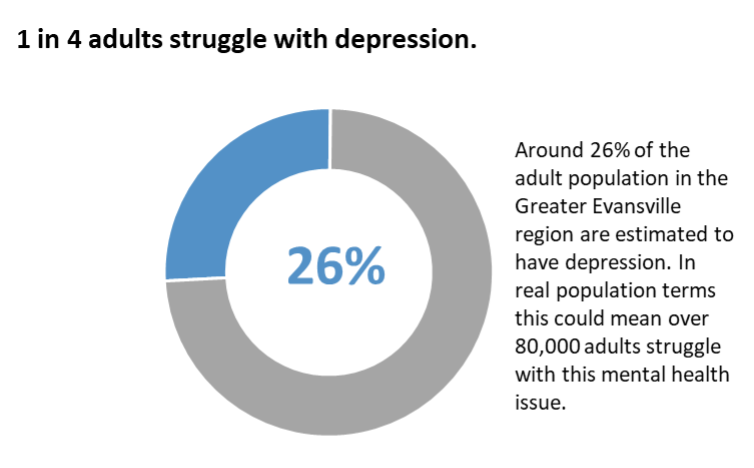
Mental health is just as important as physical health, and it impacts everyone differently. John might be surprised to learn that over a quarter of adults in our community are grappling with depression. Many others cope with challenges like sleep deprivation (34%) or a lack of physical activity (26%), which help manage well-being through positive habits. Around 16% battle excessive drinking, a habit that can worsen mental wellbeing and create a host of other negative consequences.
John knew he needed help, but the thought of getting help felt overwhelming. Appointments, insurance, transportation – it all seemed like a lot to navigate. John’s concerns aren’t unfounded. Here in our region, 6% of adults lack health insurance and 12% of households are below the poverty level – barriers that could make accessing help challenging. Transportation can also be a hurdle – 6% of households in our region lack car access and 9% of households have no computer or internet, making telehealth a difficult option. These obstacles only get worse in certain rural areas and neighborhoods. But there’s good news: talking about mental health is becoming more common and the issues and barriers are on the radar.
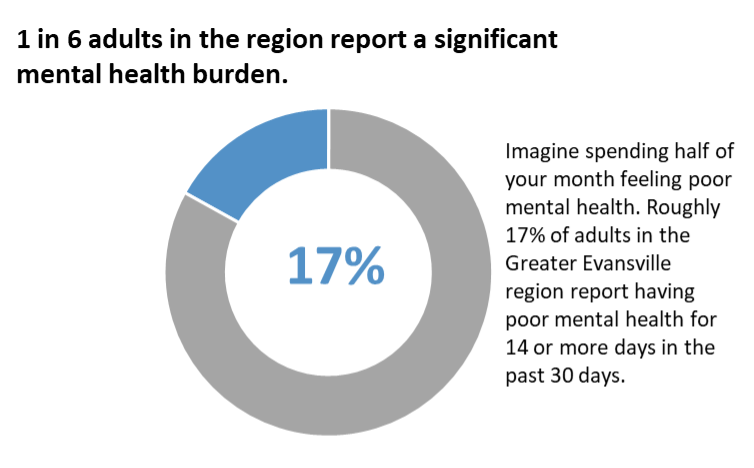
Data on “depression” and “poor mental health days” begins to help us understand the prevalence of mental health issues in our region’s adults.
From a data standpoint, improving mental health for John and the region requires a better understanding of the prevalence of mental health issues and needs for residents of all ages, and the systems that are in place or are needed to support those needs. Exciting things are happening at the state and local levels on the data front. Mental health collaboratives, universities, health systems, and others alongside providers and champions of mental health are working together to better understand mental health needs and the systems that are there to support those needs. Solutions are multi-faceted and will be better informed with better data.
John does already have options in our region with quality providers and services, but his story is also one of the possibilities. With a growing movement towards mental health awareness and using data for action, John, and others in need of mental health support will have better visibility and access to help when it’s needed to navigate life’s obstacles and emerge stronger.
Find more data on mental health
Here are quick links to Grow/SAVI resources to help you learn more about your community. Stay tuned as SAVI continues to add more mental health related data!
- Community Profile Tool – data for specific geographies, like counties, zip codes, and neighborhoods. (Pro tip: not all data is available for small geographies, like neighborhoods. If you run into missing data, try a slightly larger area, like the zip code that encompasses the neighborhood.)
Grow Library – Entering “mental health” in the search bar will show you articles, papers, surveys, statewide strategies, and more.
May is Mental Health Awareness Month. Let’s bring awareness to mental health issues in our region! Share your data insights on this topic with colleagues, community partners, and on social media.